
Dental Abscess Warning Signs
Toothache with swelling, fever or a bad taste can signal a dental abscess, according to Healthdirect. Seek urgent assessment. Breathing or swallowing difficulty, or swelling near the eye or neck, needs emergency medical care.
Call 0417 516 168When to call 000 or go to hospital
- Call 000 or go to an emergency department for difficulty breathing, speaking or swallowing. Healthdirect and the NHS identify eye or neck swelling, a painful eye or vision change, extensive mouth swelling or marked difficulty opening the mouth as reasons for immediate hospital assessment.Sources: [1, 2, 5]
Do this now
Seek urgent assessment from a dentist or doctor for a suspected abscess. Healthdirect explains that it will not clear by itself and that antibiotics do not replace dental treatment.Sources: [3]
Call 0417 516 168 for an available same-day emergency appointment during opening hours. No after-hours service is offered. Seek another available service if urgent care cannot be arranged here.
On this page
Which symptoms can suggest a dental abscess?
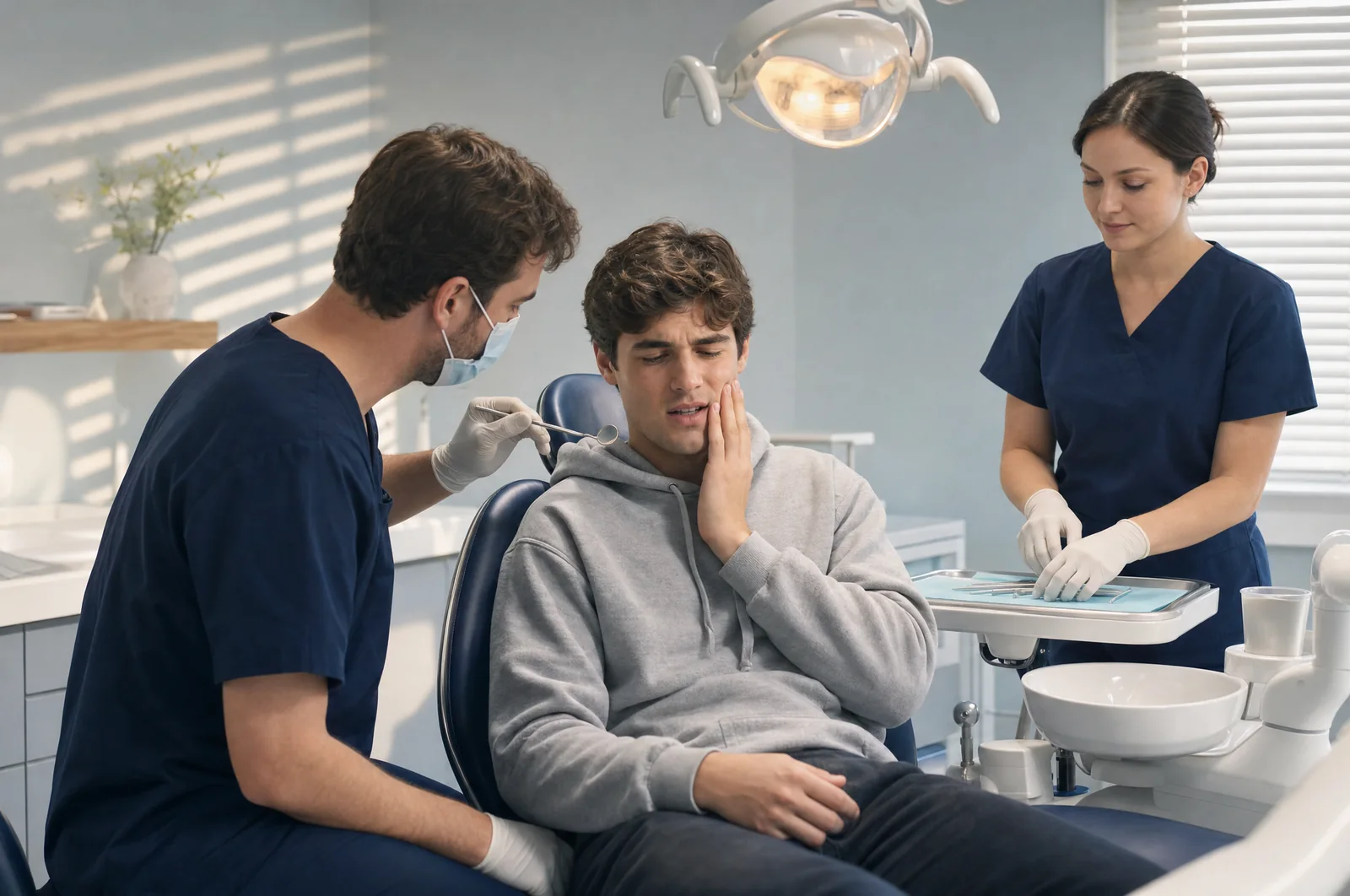
Toothache, sensitivity, swelling, fever or a bad taste can suggest a dental abscess, according to Healthdirect. An abscess is a collection of pus associated with infection in or around a tooth or gum. Symptoms suggest a need for assessment, but cannot confirm the diagnosis or show how far an infection has spread.Sources: [3, 5]
- Emergency dentist in West Perth
Use the emergency overview after checking the hospital warning signs.
You may notice a painful tooth first, or wake with a swollen cheek and wonder whether the two are connected. Tell the dentist about both. You do not need to identify the exact tooth or find a visible lump before asking for help.Sources: [3]
Healthdirect describes abscess pain as sharp or throbbing and sometimes worse when biting or chewing. The surrounding gum can look red or feel warm, and a tooth may feel loose. Other dental problems can also cause pain, so a symptom list is not an at-home test.Sources: [3, 1]
When you call, describe what has changed: where the pain or swelling is, when it began and whether it is increasing. Mention fever, a bad taste and any difficulty opening the mouth, swallowing or breathing. Lead with the most serious symptom, rather than only asking for a toothache appointment.Sources: [3, 5]
When do you need a dentist, a doctor or hospital care?
A suspected abscess needs urgent dental or medical assessment, as Healthdirect advises. A dentist can assess and treat the dental source; a doctor may assess illness or help direct urgent care. Healthdirect identifies breathing difficulty or eye or neck swelling as reasons for emergency medical care. Do not use a routine appointment as a waiting plan.Sources: [3, 1]
Emergency warning signs are action signals, not a checklist you need to complete. One serious symptom is enough to act. A previous phone call or appointment does not mean you should wait if your condition changes.Sources: [1, 5]
If a hospital or doctor has treated an acute problem, ask who will deal with the underlying tooth or gum problem and when. Treating illness and completing dental treatment can be separate parts of the same care plan.Sources: [3]
| Symptoms or situation | Immediate action | Purpose and next decision | |
|---|---|---|---|
| Urgent dental assessmentSources: [3] | Possible abscess: pain, gum or facial swelling, fever or bad taste. | Contact a dentist urgently. | Find and treat the source, and decide what further care is needed. |
| Urgent medical assessmentSources: [3] | Suspected abscess when dental care cannot be reached, or concern about illness. | Seek a doctor's advice urgently; explain the dental symptoms. | Assess severity and arrange the appropriate next care; dental treatment may still be needed. |
| Emergency departmentSources: [1, 2, 5] | Breathing, speaking or swallowing difficulty; eye symptoms, neck swelling or extensive mouth swelling. | Get immediate hospital help; call 000 for an ambulance when needed. | Assess a possible serious complication. Do not wait for routine dental care. |
How can an abscess develop, and what history matters?
An abscess can develop when bacteria reach tissues inside a tooth or around its root, as Healthdirect explains. Decay, cracks, dental injury and gum disease are possible starting points. Some health conditions and medicines also matter to assessment. Tell the clinician about your dental and medical history instead of trying to select the cause yourself.Sources: [3]
A tooth can be affected beneath the surface you see. Healthdirect describes problems such as deep fillings, failed root canal treatment and partially erupted or impacted teeth among possible contributors. The clinician must determine which findings are relevant to your symptoms.Sources: [3]
Bring a list of medicines and explain health conditions, including anything that affects your general health or treatment. Say whether the tooth has been injured or treated before. You do not need to decide whether an old dental procedure caused the present problem; give the history and let the clinician assess it.Sources: [3, 1]
What happens when a suspected abscess is assessed?
Assessment usually begins with your symptoms and an examination of the mouth, face and neck, as Healthdirect describes. A clinician may arrange imaging or other tests to understand the cause and severity. The tests needed depend on the findings. Ask what each step is intended to establish and whether treatment is needed immediately.Sources: [3]
At first contact
Explain the symptoms
Describe pain, swelling, fever and any trouble breathing, swallowing or opening the mouth. Tell the team how symptoms have changed and what care or medicines you have already received.Sources: [3, 5]
During assessment
Identify the source
Healthdirect describes an examination, with an X-ray or other tests when needed. Ask whether the problem appears to involve the tooth, the gums or a more extensive infection.Sources: [3]
After the findings are explained
Agree on treatment
Ask what addresses the source, what any medicine is for and whether another clinician or hospital needs to be involved. Healthdirect explains that antibiotics alone do not complete abscess treatment.Sources: [3]
Before leaving
Set the review plan
Confirm how to obtain help if symptoms worsen, which treatment remains and when reassessment is planned. Your dentist will discuss the appointment stages, timing and follow-up for your individual care.Sources: [3]
- Our dentist in West Perth
Read Dr Michael Wu's qualifications, registration and clinical review details.
How do treatment options differ, and why are antibiotics not enough?
Abscess treatment must address the source of infection. Healthdirect describes drainage, root canal treatment, tooth removal or treatment around the gums, depending on the findings. Healthdirect and Queensland Health explain that antibiotics may be part of the plan but cannot replace the necessary dental treatment. A clinician must decide which options fit your situation.Sources: [3, 4]
Do not try to drain an abscess yourself. Healthdirect and NHS guidance describe professional drainage and treatment of the source. Pain medicines and home comfort measures do not turn that procedure into a safe home task.Sources: [3, 5]
| What the option addresses | Decision to clarify | What it does not establish | |
|---|---|---|---|
| DrainageSources: [3] | A collection of pus. | How will the underlying source also be treated? | That no further dental care is needed. |
| Root canal treatmentSources: [3] | A source involving the inside of a tooth. | Can the tooth be treated and retained? | That every affected tooth is suitable. |
| Tooth removalSources: [3] | An affected tooth selected for removal after assessment. | Why is retaining the tooth not the recommended approach? | That pain alone determines the choice. |
| Treatment around the gumsSources: [3] | A gum-related source. | What cleaning or other gum care is needed? | That the same treatment suits every abscess. |
| Antibiotics when prescribedSources: [3, 4] | Help fight infection when clinically indicated. | What other treatment and review are required? | That antibiotics alone remove the source. |
- Dental abscess
Read the related treatment discussion guide.
What can you do while urgent treatment is being arranged?
Choose soft foods, avoid very hot or cold drinks and keep your mouth gently clean while arranging urgent care, as NHS guidance advises. Ask a pharmacist or doctor about suitable pain relief and follow the label. These measures may ease symptoms; they do not treat the infection or make it appropriate to delay assessment.Sources: [1, 5]
Choose food you can manage without provoking the painful area, such as a soft meal rather than something that needs hard chewing. The NHS recommends a soft toothbrush to continue cleaning. If eating or drinking becomes difficult, tell the clinician rather than assuming you must simply put up with it.Sources: [1, 5]
For swelling, a cold pack wrapped in cloth can be held against the outside of the face. Do not place aspirin directly on the tooth or gum: Queensland Health warns that it can burn soft tissue. Ask for individual advice about medicines instead of applying them to the sore area.Sources: [1, 4]
Keep the urgent care plan active even if a comfort measure helps. Tell the service if symptoms worsen while you are waiting. If emergency warning signs appear, seek hospital help rather than waiting for the arranged dental visit.Sources: [3, 5]
How can treatment feel, and what should improvement look like?
Ask the treating clinician how discomfort will be managed during and after abscess treatment. The NHS describes local anaesthetic during abscess treatment. Healthdirect describes improvement within two to three days after treatment starts, but this is a reassessment guide, not a promise. Worsening symptoms need earlier attention.Sources: [5, 3]
Before a procedure, tell the clinician about pain, anxiety and any difficulty opening your mouth. Ask what you may feel, how to signal that you need a pause and what the pain-relief plan is afterwards. The NHS describes local anaesthetic for treatment; this does not establish how every stage will feel for you.Sources: [5]
If you are not starting to improve within the period discussed, contact the treating clinician. Healthdirect says further tests or different treatment may be needed when improvement does not occur. Do not extend a general recovery expectation while symptoms get worse.Sources: [3]
Feeling better and finishing treatment are different milestones. Ask whether a temporary measure has been used, whether more tooth or gum treatment remains and who will arrange it. Keep the follow-up plan clear even if pain no longer drives the decision.Sources: [3]
Ask for individual advice about food, cleaning and daily activities after the actual procedure you receive. A single timetable cannot cover drainage, root canal care, removal and more serious infection.Sources: [3]
Why does follow-up matter, and what may reduce future risk?
An untreated dental abscess can spread beyond the tooth and become serious, as Healthdirect explains. Follow-up checks whether the infection and its cause have been addressed. Healthdirect recommends regular dental care, fluoride toothpaste and cleaning between teeth to help reduce future risk. Preventive habits do not replace care for an existing infection.Sources: [3]
Healthdirect explains the risk of infection spreading; this is the reason for urgency, not a prediction that every abscess will lead to a severe complication. Ask what signs the clinician wants you to watch for and how to get help if they occur. Keep those instructions where you can find them.Sources: [3]
Healthdirect recommends brushing at least twice a day with fluoride toothpaste, cleaning between teeth daily and attending dental check-ups. Ask which parts of your own care routine need attention. A practical plan should relate to the cause identified at assessment, rather than blame you for having symptoms.Sources: [3]
- Toothache assessment
Explore other causes of dental pain.
- First aid after a knocked-out tooth
Use the injury guide if a new accident has occurred.
What costs should you clarify without delaying urgent care?
Arrange urgent assessment first, then ask what the proposed care includes. Assessment, tests, immediate treatment, medicines, further tooth or gum treatment and review are separate items to clarify. Call 0417 516 168 for a same-day emergency appointment during opening hours. Mon–Fri 8am–8pm, Sat 8am–1pm, Sun closed; by appointment. No after-hours service. A general article cannot provide your treatment quote.Sources: [3]
Ask what the first appointment is intended to achieve and which later costs may be estimated only after the findings are known. If the plan changes, ask for the updated scope in writing. Do not assume a quote for an urgent visit includes every later stage.
If you are referred elsewhere, ask who will provide the next part of care and how costs are explained. Health fund benefits, payment options and any clinic conditions must be confirmed directly; none is established by the clinical sources.
Tell the treating service if cost affects your ability to follow the plan, and ask about available care pathways. Do not silently postpone a recommended urgent step. The aim is to leave with a clear next action and a way to obtain further advice.Sources: [3]
- Dental fees and payment questions
Check payment options and what to ask about your written estimate.
What can public guidance not tell you about your infection?
Healthdirect explains warning signs and treatment roles, but its general guidance cannot diagnose your symptoms or select a procedure or medicine for you. It does not predict how serious an individual infection will become. Your examination, health history and response to treatment guide the clinician's decisions and follow-up advice.Sources: [3]
Use a general guide to prepare questions, not to overrule a new finding at assessment. Ask the clinician to explain why their recommendation fits your situation, what alternatives remain and what would make them change the plan. No recovery date or tooth-retention outcome is promised.
What if pain eases, the lump is hard to see or you still have questions?
Less pain or no obvious lump cannot confirm that an infection has gone. Healthdirect explains that a suspected abscess still needs assessment and treatment. Public guidance also cannot determine whether your tooth can be retained. Ask the clinician to explain the findings and the remaining uncertainty.Sources: [3]
Does a better day mean you can cancel? Healthdirect explains that an abscess still needs treatment when pain eases. Tell the dentist how symptoms have changed and ask about the planned assessment rather than deciding from pain alone.Sources: [3]
Can a photograph confirm an abscess? Healthdirect describes examination and, when needed, tests to identify infection; a photograph cannot replace that assessment. Describe symptoms and seek care rather than waiting for a visible change to photograph.Sources: [3]
If antibiotics are prescribed, what should you ask? Ask what they are intended to do, how to follow the instructions, what concerns to report and which dental treatment is still required. Healthdirect and Queensland Health explain that antibiotics do not replace the required dental treatment.Sources: [3, 4]
- Contact Simply Smiles West Perth
Call 0417 516 168 for a same-day emergency appointment during opening hours. Mon–Fri 8am–8pm, Sat 8am–1pm, Sun closed; by appointment. No after-hours service. Seek another available service if care is needed now.
- Emergency dentist in West Perth
Return to the emergency overview.
- Dental advice articles
Browse the four guides after arranging care.
Sources
Numbers in brackets point to these public sources.
- Healthdirect Australia: Toothache and gum swelling. Accessed 6 October 2026.
- Healthdirect Australia: Dental injury. Reviewed February 2026. Accessed 6 October 2026.
- Healthdirect Australia: Tooth abscess. Accessed 6 October 2026.
- Queensland Government: Emergency dental. Accessed 6 October 2026.
- NHS: Dental abscess. Reviewed 18 March 2026. Accessed 6 October 2026.
Clinical review
This guide was reviewed by the dentist named below. About our dentist
- Reviewing dentist
- Dr Michael Wu
- Qualifications
- Doctor of Dental Medicine (UWA)
- AHPRA registration
- DEN0002758483
- Review date
- 7 October 2026
Source access dates record when the research was checked. They are not clinical review dates.